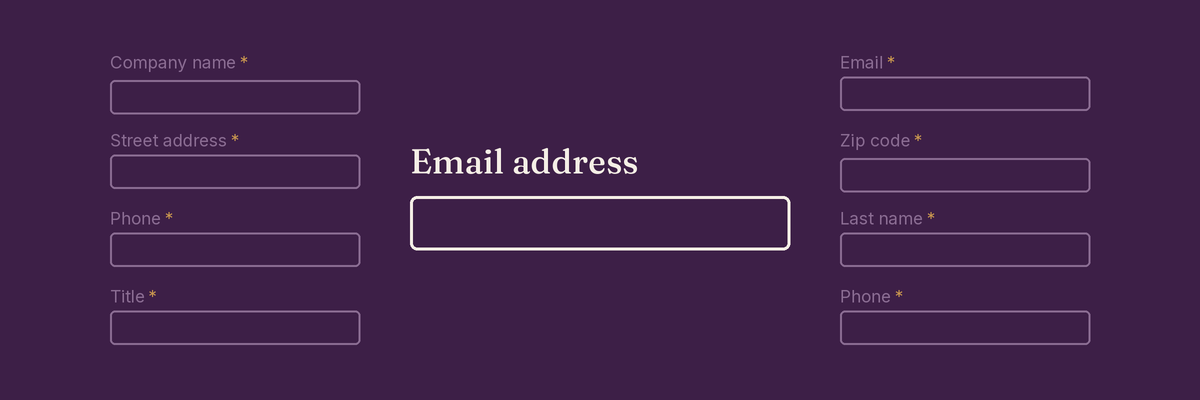
Last week I signed up for a city chamber of commerce newsletter. I wanted the event calendar in my inbox. That’s it. That should have been the whole transaction.
A chamber is supposed to be a town’s front door for business. Its whole job is to be open, welcoming and easy to find things out from, especially for the new business owner who doesn’t know anybody yet. So it’s worth looking at what that front door asked of me.
Here’s what the form asked me for.
Company name. Street address, required. City, state, zip and country, all required. A phone number for the company. An email address for the company. The company website. Then a section called Primary Contact, which asked for my first name, my last name, the name I go by, my title, my email address and my phone number.
If you’re keeping count, that’s my email twice and my phone twice, on one screen, a few inches apart. It also wanted my street address, for a newsletter that arrives by email.
I filled it out, because it’s my job to fill these out and then complain about them. Most people won’t.
It isn’t a newsletter form
Once you’ve built a few of these, you can see what happened. This isn’t a newsletter form. It’s the chamber’s database record, set out in front of the newsletter like a welcome mat.
Their system tracks companies and people as separate records, which is a perfectly sensible way to run a membership organization. A company has an address and a main phone. A person has their own email and phone. Somebody connected the signup page straight to that structure, so the form asks for everything both records hold, and I get asked twice.
The required street address is the tell. A newsletter doesn’t need it. A sales pipeline does. Somewhere in that building, someone wants to know which businesses are nearby and not yet members, and the newsletter form is how they find out. That’s a reasonable thing for a chamber to want; members pay the bills. It’s just a different thing than the form promised me. And it means the newcomer the chamber most needs to reach, the one-person shop that isn’t sure it belongs yet, meets a membership sales form before it ever sees a calendar.
Every required field is a reason to stop
A signup form is a deal. You tell people what they’ll get, and they decide whether it’s worth what you’re asking. Asking for an email address to get a newsletter is a fair trade. Asking for a street address, a title and the same phone number twice to get a newsletter isn’t, and people feel that even when they couldn’t tell you why.
So they stop. They don’t write in to complain. They close the tab, and you never find out they were there. The form doesn’t log the people it lost. Its numbers only include the people stubborn enough to finish, and those people were going to sign up anyway.
That’s the part I’d want a board to hear. A long form doesn’t look like a problem from the inside, because the data you do get is beautiful. Every record is complete. You just have fewer of them than you should, and nothing in the report shows the gap.
Ask for what this moment needs
The fix isn’t to stop wanting the information. It’s to stop asking for all of it at once.
Ask for what this step actually needs. A newsletter needs an email address, and maybe a first name so the greeting isn’t “Dear Subscriber.” Everything else can wait for a moment that actually needs it: when someone registers for an event, joins, donates or asks you to call them. By then they’ve got a reason to tell you more, and they will.
Make the rest optional, and mean it. If a field doesn’t have a real use in the next step, it shouldn’t have a red asterisk.
Ask once. If the person and the organization share an email address, let one field fill both. If your software can’t do that, that’s worth knowing before you build the next form on it.
Say why. “We ask for your zip code so we can tell you about events near you” turns a nosy question into a helpful one. If you can’t finish that sentence for a field, you probably don’t need the field.
I’m not writing this to call out a chamber. I’m writing it because I build websites and make sense of data for a living, and when I run into something this far off, I take notes. A form like this is almost never a decision anyone made. It’s what happens when nobody goes through it as the person on the other end before it ships. That takes five minutes, and it’s the cheapest check there is. Most organizations have a form like this somewhere. Most of them have never filled it out themselves.
The same lesson from the other side
In September I wrote about a registration form that let bad data in, and how no amount of cleaning afterward could keep up with it. This is the same lesson from the other side. A form can fail by asking too little, and it can fail by asking too much. Either way, the form is where your data starts, and it’s the cheapest place to fix anything.
Next time you look at one of your own forms, try filling it out as a stranger who wants exactly one thing. Count the fields between them and that one thing. Then ask which of those fields you’d still keep if every one of them cost you a few people.